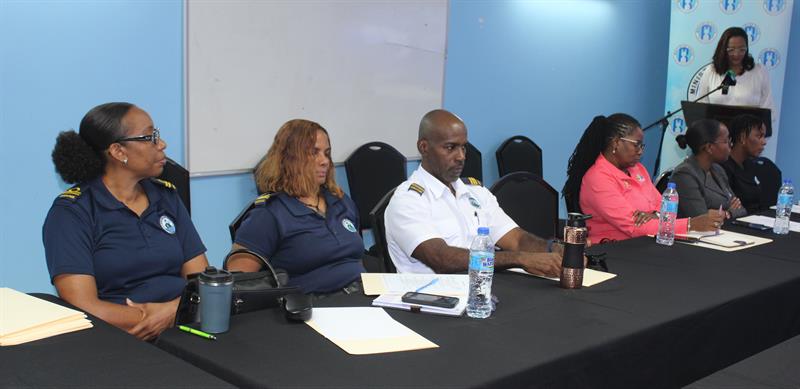
 The Environmental Health Division within the Ministry of Health, Wellness and Nutrition recently hosted a port health stakeholder training, aimed at strengthening Saint Lucia’s capacity to prevent, detect, communicate and respond effectively to public health threats at air and sea ports of entry.
The training brought together representatives from the Environmental Health Division, Customs and Excise Department, St. Lucia Air and Sea Ports Authority and Immigration Department to reflect on the Standard Operating Procedures (SOPs) for port health functions in response to public health threats.
Chief Medical Officer, Dr. Sharon Belmar-George commended the initiative to strengthen port health capacity, stressing that continuous training and multi-agency cooperation is necessary. “It is important to ensure that every agency, every stakeholder is continuously updated on what to do if there is a suspected threat. So, this is why Standard Operating Procedures (SOPs) are important. They provide us with a common framework for action, particularly when we are operating under pressure, but procedures are only effective when the people responsible for implementing them, understand them, have practiced them and know how their responsibilities can connect with those of other agencies.”
Chief Medical Officer, Dr. Sharon Belmar-George highlighted the importance of strengthened collaboration, multi-agency cooperation and clearer communication for effective preparedness and response to public health threats. “The workshop also provides an opportunity to reinforce the principal that preparedness is a shared responsibility. Our ports must remain safe, secure, resilient and capable of supporting the continued movement of people and goods while protecting public health. This required sustained collaboration, rather than cooperation only when an emergency occurs.”
The port health stakeholder training covered disease surveillance, International Health Regulations (IHR) compliance, and public health emergency response. It entailed presentations, open discussions and tabletop simulation exercises to help stakeholders practice working together during a public health emergency at a port of entry.
Real Estate