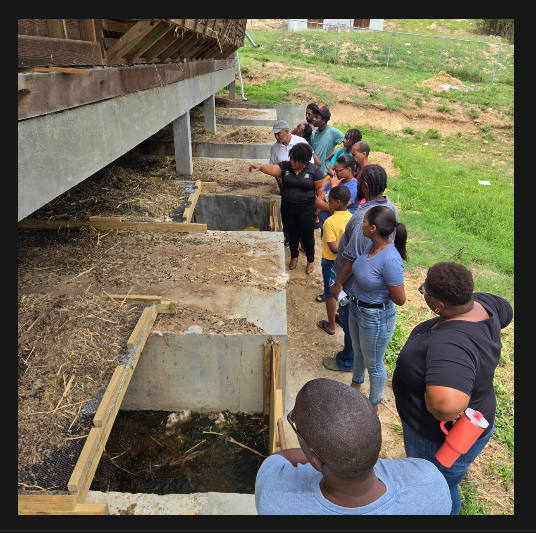
 Saint Lucian farmers have recently been increasing their knowledge about vermicomposting through a programme designed to introduce them to the many benefits of the agricultural technique.
An informational workshop was held at the Volet Agricultural Station in Micoud from Tuesday, July 14 to Thursday, July 16, 2026, to equip farmers with the knowledge and practical skills needed to adopt vermicomposting as a sustainable, climate-smart agricultural practice. As climate change continues to affect agriculture through prolonged droughts, intense rainfall, soil degradation, and rising input costs, there is an increasing need for farming practices that improve resilience while maintaining productivity.
The workshop was facilitated by two technical officers from the Ministry of Agriculture, Fisheries, Food Security and Sustainable Development, Ms. Kishma Louis and Mr. Greg Michel, alongside the lead facilitator, Mr. Dean Avril, a consultant, and resource persons with expertise in soil management, vermicomposting, and climate-smart agriculture.
The workshop introduced participants to the principles and techniques of vermicomposting, demonstrating how biodegradable organic waste, including crop residues, livestock manure, and kitchen waste, can be transformed into a high-quality organic soil amendment. Through both classroom instruction and hands-on practical sessions, farmers learned how to establish and manage vermicomposting systems, produce quality vermicompost, and apply it effectively to improve soil health and crop performance.
Beyond the technical aspects, the workshop sought to encourage a shift toward more sustainable farming practices by promoting resource efficiency, reducing waste, and decreasing dependence on synthetic fertilizers. Farmers were also introduced to a permanent vermicompost bin at the Volet Agricultural Station, where they observed the performance of vermicompost under real-field conditions, allowing them to make informed, evidence-based decisions about adopting the technology on their own farms.
This initiative forms part of the Ministry of Agriculture’s ongoing commitment, under the South East Coast Project (SECP) with support from TaiwanICDF, to strengthen farmers’ resilience to climate change, improve soil health, and promote environmentally sustainable agricultural production in Saint Lucia.
Vermicomposting is much more than a method of recycling organic waste; it is a practical, climate-smart technology that helps farmers improve soil health while reducing production costs and protecting the environment. Through the activity of earthworms and beneficial microorganisms, biodegradable materials such as crop residues, livestock manure, and vegetable waste are converted into a stable, nutrient-rich organic amendment known as vermicompost.
The benefits of vermicompost extend beyond simply supplying nutrients. It improves soil structure by increasing soil organic matter, making soils more friable and easier for plant roots to penetrate. It also enhances the soil’s ability to retain moisture, which is particularly important during prolonged dry periods and droughts that are becoming more common due to climate change. During periods of heavy rainfall, healthier soils are also better able to absorb and retain water, reducing run-off and soil erosion.
Vermicompost supports a diverse population of beneficial microorganisms that improve nutrient cycling and soil biological activity, making essential nutrients more readily available to plants over time. As a result, farmers often experience healthier crops, stronger root development, improved plant vigour, and, ultimately, better yields and crop quality.
Another important advantage is that vermicomposting allows farmers to transform materials that would otherwise be discarded into a valuable on-farm resource. By producing their own organic soil amendment, farmers can reduce their dependence on purchased fertilizers, lower production costs, and improve the long-term sustainability of their farming systems.
Overall, vermicomposting contributes to healthier soils, more resilient farms, improved environmental stewardship, and greater food security, making it an important climate-smart practice for agriculture in Saint Lucia.
The workshop formed part of ongoing efforts to promote climate-smart agriculture with the South East Coast Project and Taiwan ICDF, implemented by the Ministry of Agriculture. In addition to classroom sessions, participants observed permanent vermicomposting units at the Volet Agricultural Station and a portable vermicompost bin, received practical hands-on training, and will participate in a validation plot activity to observe how vermicompost performs under field conditions. These activities encourage farmers to make evidence-based decisions about adopting sustainable soil management practices that improve productivity while protecting natural resources.
Farmers who wish to start practicing vermicomposting are advised to start small and use materials that are readily available on their farms, such as crop residues, vegetable waste, and animal manure. They should also maintain adequate moisture, avoid adding meat, oils, or chemically treated materials, and ensure the worms are protected from excessive heat and direct sunlight. Most importantly, be patient — healthy vermicompost takes time to produce, but the long-term benefits to soil health and crop productivity make it a worthwhile investment.
Real Estate
