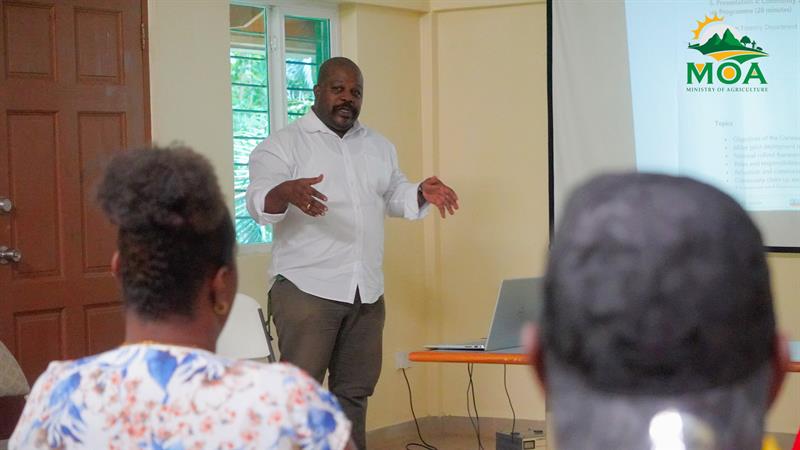
 Government agencies and national partners have strengthened collaboration on snakebite prevention, environmental management and public safety through a Multi-Agency Planning Meeting held at the Forestry Conference Room. The meeting advanced preparations for the Community Snake Handler Pilot Project, including a Community Clean-Up Action scheduled for 11 August 2026 at the Tete Chemin Community Centre in Millet.
Convened by the Division of Forest and Land Resources Development, the meeting brought together representatives from the Department of Agriculture, Fisheries and Food Security, the Ministry of Health, Wellness and Nutrition, the Saint Lucia National Trust and other stakeholders to coordinate responsibilities and finalize plans.
Permanent Secretary in the Ministry of Agriculture, Fisheries, Food Security and Sustainable Development, Bradley St. Ange, underscored the importance of coordinated action across agencies. “The success of this initiative depends on effective collaboration across government and with our communities. The Forestry Division will provide technical leadership and programme coordination, while our partner ministries and agencies will contribute according to their respective mandates and areas of expertise.” he added.
Conservation Officer at the Saint Lucia National Trust, Murlina Murray, emphasized the critical need for greater public awareness and education about the island’s snake species. “Much more education and public awareness are needed regarding the snake species found in Saint Lucia. Many people are unable to identify the different species. Some may say, ‘If I see a snake, I’m not going to stop to determine what type it is, I’ll just try to kill it.’ However, attempting to kill a snake can sometimes put you at even greater risk. That is why public education is so important. People need to understand the different snake species found in Saint Lucia and know how to respond safely when they encounter one,” she added.
Senior Medical Officer within the Ministry of Health, Wellness and Nutrition, Dr. Delphina Vernor, reminded the public that prompt medical treatment is critical following a venomous snakebite. “The Ministry of Health wants the public to know that the definitive treatment for a bite from a venomous snake, such as the fer-de-lance found in Saint Lucia, is antivenom. However, antivenom must be administered safely in facilities equipped to manage any serious allergic reactions or complications that may occur. For this reason, antivenom is administered only at St. Jude Hospital, the Owen King EU (OKEU) Hospital at the Millennium Heights Medical Complex, and Tapion Hospital. These facilities have specialist staff, emergency medications, laboratory services and critical care support needed to ensure safe treatment. Antivenom is therefore not administered at primary healthcare facilities,” Dr. Vernor noted.
Senior Environmental Health Officer Glenda Etienne Cepal highlighted the importance of environmental sanitation in reducing snake habitats. “One of the key factors we recognize is that an increasing rat population can attract snakes into an area, as rats are a primary food source. From a Vector Control perspective, we will bring our expertise to the Millet community to support efforts to reduce rodent populations and strengthen environmental health measures that help minimize the risk of snake encounters,” she noted.
The initiative forms part of the Government’s broader commitment to protecting public health, conserving biodiversity and enhancing community resilience through coordinated, evidence-based interventions.
Real Estate
