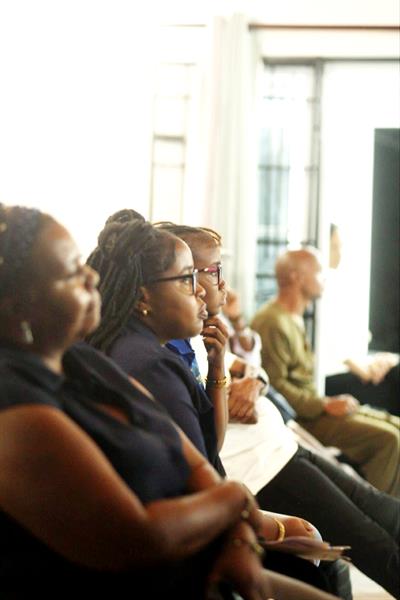
 “If you understand our past, you’ll understand why reparations matter. So, what are you going to do about it?”. That was the powerful question posed by educator, cultural advocate, and self-described “Bacchanalist” Sherween Gonzales as she discussed how she became a part of the Caribbean reparations movement.
Admittedly, she never set out to become a community organiser for reparations, but in many ways, her entire life pointed her in this direction. As an educator, creative, and advocate she was always driven by a desire to help others, especially youth, develop a deeper understanding of self, one tied to history and culture.
In her newest role, as a Community Organiser for The Repair Campaign, however, Sherween has taken her mission beyond school walls and Mas, as she brings the call for reparations into the heart of every community on the island. Her motivation is personal.
“This may sound naive, but I grew up in Saint Lucia not seeing colour,” Sherween reflected. “The concept of racism didn’t feel real to me until I moved to the UK in the early 2000’s. At that time my eyes were forcefully opened to the way we as Caribbean people, as African descendants, are viewed in the world.”
That realisation was further compounded by the discovery that her British husband’s ancestors were closely tied to chattel enslavement and colonisation in the Caribbean. What started as a harsh revelation, though, eventually became the catalyst for a journey of research, self-discovery and re-education.
The journey to repair begins with knowledge
“I started asking, why don’t we know these things? Why aren’t we talking about them? Why aren’t we learning this in school? “Sherween said. “I’ve always believed that education is the key, and when it comes to reparations, people need to first know where it comes from to understand why it matters, and what it could look like in our lives today.”
Sherween’s work is grounded in an understanding of Saint Lucia’s history, from the legacies of colonisation and enslavement to the ongoing economic and social disparities that stem from that past. “We often think these things are over, they’re not,” she explains. “The impact is still here, in our healthcare, our education system, the way wealth is distributed. When we understand how our history shaped that, we can start to have real conversations about repair.”
Bringing the Reparations Conversation to the People
Those types of conversations are exactly what Sherween began during her first official event as a reparations Community Organiser on January 26th. She addressed the audience with a moving personal statement, “When I moved back to St. Lucia in 2022, living here again only deepened my sense of purpose. There were certain realities that stayed with me. Most St. Lucians cannot access farmland; tourism dominates our economy and food insecurity is on the rise. These realities are not separate from the story of slavery. They are direct continuation of land disposition and economic exploitation”.
She concluded with the powerful declaration, “reparatory justice is not only about the past, but also about the future – who gets land, who gets opportunity, who gets to thrive. This is a fight we share across the Caribbean, and this is a future we can build together.”
Building Bridges, Not Silos
Sherween knows that the reparations conversation in the Caribbean hasn’t reached many people. “We’ve seen strong advocacy from the Rastafarian community, and important work done at the academic and policy levels but for many people, reparations still feel distant,” she says. “I want to change that. I want people to know this is about them. Their families. Their communities. Their future.”
Her role spans grassroots outreach and public education, to connecting stakeholders who rarely work together. She’s building bridges between generations and sectors. Her commitment to using education as a pathway to empowerment plays a central role in this work.
What comes next
Sherween’s introductory event was just the beginning, she is already planning a series of community engagements across the island, aiming to connect with schools, youth groups, faith organisations, and civic leaders.
“Saint Lucians have been resisting and organising for justice for generations. I see my work as continuing that tradition. Our people are ready,” she said. “They just need to be brought into the conversation in a way that feels real. And that’s my job, to open that door.”
As she steps forward to participate in this new chapter of the movement in Saint Lucia, she carries both the weight of history and the promise of what is possible.
About The Repair Campaign
The Repair Campaign was founded in 2022 to support the movement for reparatory justice in the Caribbean, guided by the CARICOM 10 Point Plan for Reparatory Justice. It aims to amplify Caribbean voices and foster meaningful dialogue on reparatory justice for countries impacted by the chattel slave trade.
The Repair Campaign engaged the Sir Arthur Lewis Institute of Social and Economic Studies (SALISES) at the University of the West Indies to develop 15 country-specific reparatory justice plans to address the enduring effects of chattel slavery, indentureship and colonialism.
Real Estate
