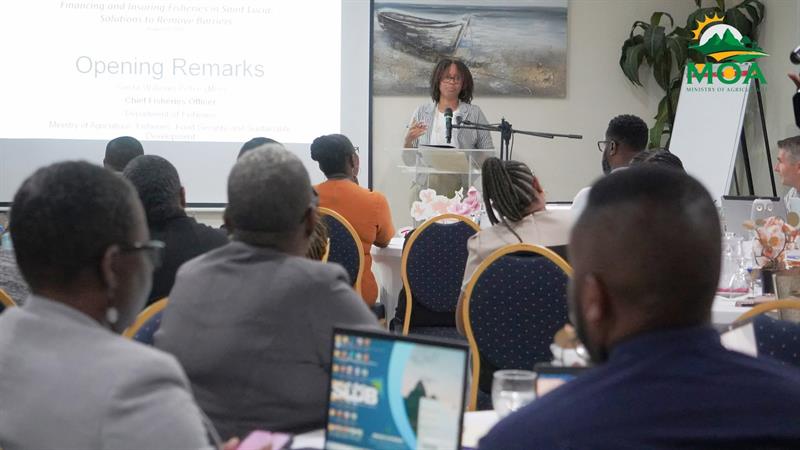
 To protect the livelihoods of nearly 5,000 Saint Lucian fishers, aquaculture workers, and seafood processors against severe climate threats, the FISH-ADAPT Project (Transforming climate resilience and sustainability in Saint Lucia’s fisheries communities) mobilized over 40 representatives from government, financial institutions, insurance companies, fisherfolk organizations, cooperatives, the private sector and development partners on August 19, 2026 to advance efforts in addressing barriers to credit and disaster insurance for the fisheries sector.
The national stakeholder meeting marked a major milestone under the FISH-ADAPT project, implemented in Saint Lucia by the Food and Agriculture Organization of the United Nations (FAO) through a grant from the Green Climate Fund (GCF) and co-financing from the Government of Saint Lucia, via the Ministry of Agriculture, Fisheries, Food Security and Rural Development and the Ministry of Finance. The initiative directly targets climate vulnerability and food security in Saint Lucia’s coastal communities.
While Saint Lucia’s fisheries supply over 1,200 tonnes of seafood annually and underpin local commerce, fewer than 10 vessel loans are issued each year, fewer than five marine hull insurance policies had been issued for fishing boats and engines over the previous three years. Worsening climate impacts, including intense storms, sargassum invasions, and gear loss, frequently threaten household incomes and compromise national food security. Through the FISH-ADAPT project, over XCD $800,000 is available for capacity building, financial literacy and the development and testing of finance and insurance products for the fisheries sector.
To address these vulnerabilities, stakeholders discussed a transformative impact roadmap that translates workshop outcomes into tangible benefits on the ground. This comprehensive strategy delivers specialized business management training, including the Micro Business Game, to equip small-scale fishers and seamoss producers with vital record-keeping skills to establish creditworthiness. Simultaneously, the roadmap fosters collaboration with key financial institutions to establish flexible working-capital facilities and seasonal loans tailored to fishing and aquafarming cycles. To further lower entry barriers, the initiative aims to standardize vessel valuations, seaworthiness inspections, and credit guarantee schemes to reduce collateral demands on small enterprises, while expanding access to specialized marine insurance and regional parametric tools like the Caribbean Oceans and Aquaculture Sustainability Facility (COAST) to ensure rapid financial recovery following extreme weather events.
Reiterating the need to bridge the gap between finance and coastal operations, Raymon van Anrooy, FAO Senior Fishery Officer, emphasized, “The challenge is not simply to make more money available; we must make viable fishing enterprises finance-ready and insurable. Financial products also need to reflect the realities of fishing. In many countries, fishing vessel loans and insurance are already profitable business lines for banks and insurers.”
According to Chief Fisheries Officer within the Department of Fisheries Sarita Williams Peter, ‘When we talk about financing fisheries, we are talking about financing an entire economic ecosystem.’ She continued, ‘Creating a sector where people can build viable businesses, secure their livelihoods, and adapt to a changing climate cannot be achieved by fisheries alone. It requires us to come together to develop financial and insurance mechanisms that are truly fit for purpose.’
Echoing the need for strong financial management at the community level, representative of the National Fishermen’s Cooperative Society Kaygianna Toussaint stressed that external financial access must be matched by internal business discipline and long-term planning: ‘It is important that fishers re-invest their earnings into the fishing business to support its growth,’ she stated, highlighting how cooperatives can bridge literacy gaps and strengthen social safety nets. ‘Most fishers do not contribute to a retirement or pension fund, and fishers’ cooperatives can help those who lack financial knowledge to make their contributions to the National Insurance Corporation.’
By aligning with Saint Lucia’s Sectoral Adaptation Strategy and Action Plan (SASAP 2018-2028), the FAO-led initiative ensures that coastal workers possess the financial safety nets necessary to withstand climate impacts and maintain sustainable, profitable businesses.
Real Estate